Stress Urinary Incontinence


The average age of presentation for Stress Urinary Incontinence in Australia is 50-60 years old and commonly occurs after vaginal childbirth. Understandably, leaking urine throughout the day has a hugely detrimental impact on the quality of life for women. The good news is that Stress incontinence management overall has great long term outcomes in regards to no more leakage, high patient satisfaction, quick recovery and low complication rates.
As a certified Urogynaecologist with subspecialty training, Dr Usama Shahid offers expert assessment and management of stress urinary incontinence including complex or recurrent cases. With a focus on holistic care he leads the stress urinary incontinence specialist Wollongong service offering the full range of evidence based treatments, including both mesh and non mesh options. Dr Shahid's focus lies in providing a personalised plan with the goal of achieving durable results and restoring confidence in everyday activities to the women of the Illawarra.
There are 2 main branches of female urinary incontinence, namely stress urinary incontinence and overactive bladder syndrome.
Overactive bladder is characterised by urge urinary incontinence (where you cant defer the need to go urinate and have to leave what you are doing and rush off to the bathroom). This is related to dysfunction of the complex circuit of nerve fibres running from the brain, to the spinal cord and then to the bladder and discussed separately here. Bladder control is significantly reduced and frequent urination and urge urinary incontinence results. Treatment options include optimising bladder function through bladder training, kegel exercises, bladder botox and sacral nerve stimulation
Stress urinary incontinence on the other hand, is characterised by leakage of urine when you laugh, cough, sneeze, run or jump. This is usually related to the urethra being hypermobile (lacking anatomical supports).
There are other specific types of incontinence including mixed urinary incontinence and overflow incontinence (from chronic urinary retention) which are managed as part of the above conditions.
In order to maintain continence with increased abdominal pressure, several parts of the pelvic floor need to be functioning together in a coordinated fashion. These include the urethral sphincter, pelvic floor muscles, the endopelvic fascia and pubo-urethral ligament. Damage to these tissues (most commonly following vaginal childbirth) means that the urethra becomes hypermobile, as its natural pelvic supports have been weakened or avulsed. Consequentially, a hypermobile urethra means that the bladder neck moves freely with increased abdominal pressure (laughing, coughing, sneezing, running and jumping) and urine leakage results. Less commonly, stress urinary incontinence can result from intrinsic sphincter deficiency, which is an internal defect in the urinary sphincter closing mechanism. Urodynamics and pelvic floor ultrasound are used to help differentiate between these types of stress incontinence as their management can vary.
The risk factors for Stress Urinary Incontinence include:
Observing symptoms only with ongoing follow up and re-discussion about all treatment options.
Pelvic floor muscle training is a coordinated program of supervised exercises done with a healthcare professional. It forms the backbone of conservative treatments for SUI. The aim of pelvic floor exercises is to strengthen and support the muscles of the pelvic floor in women, thereby decreasing urethral hypermobility and urinary incontinence symptoms. Dr Shahid works closely with several local physiotherapists specialising in pelvic floor exercises to keep your pelvic floor muscles strong and effectively support your pelvic organs. Below is a basic regime you can implement while awaiting review:
A vaginal pessary is a removable silicone device placed inside of the vagina by a doctor. It supports and corrects urethral hypermobility. Compared to pessary use for prolapse, pessaries used for stress incontinence have much lower success rates. Other risks of pessaries include discomfort, difficulty with insertion or removal and ulceration of the vagina. In very rare cases a fistula can develop.
Vaginal oestrogen therapy is a safe, topical cream which strengthens vaginal tissues. It is a low risk intervention which doesn't cure stress incontinence but improves the health of vaginal tissues and the urinary system as part of management. Occasionally some women can develop a local reaction vaginal oestrogen which usually resolves after cessation of use. There is well established long term data that the use of vaginal oestrogen is safe in women with a previous history of breast cancer.
Avoiding heavy lifting: as over long periods of time recurrent heavy lifting places excessive pressure on the pelvic floor muscles leading to weakness and urethral hypermobility.
Altering bladder habits by undertaking a timed voiding regime and managing fluid intake. A bladder which is less full is less likely to leak.
Genito-Urinary Syndrome of Menopause (GSM) which results in vaginal dryness and can exacerbate symptoms of stress incontinence. Correction of this is pertinent for other aspects of women's health particularly sexual function.
Diabetes can weaken vaginal tissues
Obesity places increased pressure on the ligaments and muscles of the pelvic floor and is a key factor that needs to be managed in order to manage stress incontinence.
Constipation in women needs to be treated in order to avoid straining.
General medication review
Surgical treatments are individually detailed below with their specific benefits and risks. .
Dr Usama Shahid will discuss all available options for your stress incontinence as an individualised experience. The decision to proceed with any management is always your choice. All options have been detailed by the Australian Commission on Safety and Quality in Health care document, found here.
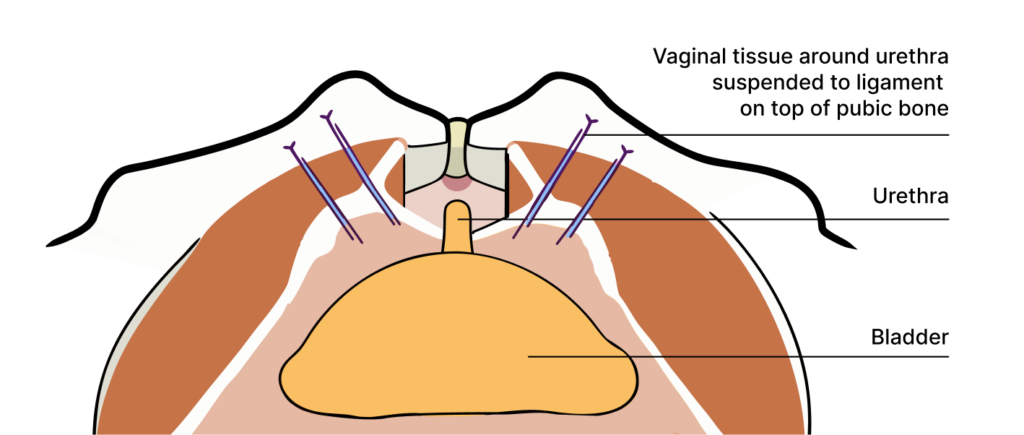
A laparoscopic Burch colposuspension is a minimally invasive surgical treatment for the correction of stress urinary incontinence. There is no mesh used in this procedure.
Under a general anaesthetic, surgical instruments are inserted through small incisions in the abdomen. Following this, the space above the bladder known as the retro-pubic space (or Cave of Retzius) is dissected. The vaginal tissue around the urethra is then elevated, and suspended with permanent sutures to the ileopectineal ligament above the pubic bone. This bladder neck suspension lifts the vagina thus correcting urethral hypermobility by forming a 'hammock' around the urethra to support it. Consequentially, this prevents leakage of urine with increased abdominal pressure from running, coughing, sneezing and jumping.
While a laparoscopic Burch colposuspension is a safe procedure, it is not without risk:
The risks include:
Most patients stay in hospital for 1-2 days.
A catheter is inserted after the operation to allow your bladder to rest and this is removed the following morning for a trial of void, to ensure you are urinating well.
In the days following surgery, temporary changes in your bowel and bladder habit are normal. This includes urinary urgency and constipation. In addition, one may experience light vaginal bleeding and discharge. In the vast majority of cases, these symptoms self resolve after 1-2 weeks.
During your stay in hospital and when you return home, you will be provided with adequate pain relief in the form of medications to support your recovery. One of the benefits of a laparoscopic approach is a much quicker recovery compared to open surgery.
You will be provided with a designated phone number to directly contact Dr Shahid following your surgery, should you have any acute concerns. In the case of an emergency, always dial 000.
You can expect some fatigue for the first few days following surgery. During this time, light activities like walking and ensuring you are adequately hydrated are encouraged. This reduces your risk of venous thromboembolism.
You will be contacted by our team and have your post-operative appointment booked in 6 weeks time. We will ensure that you are closely followed up.
What to avoid:
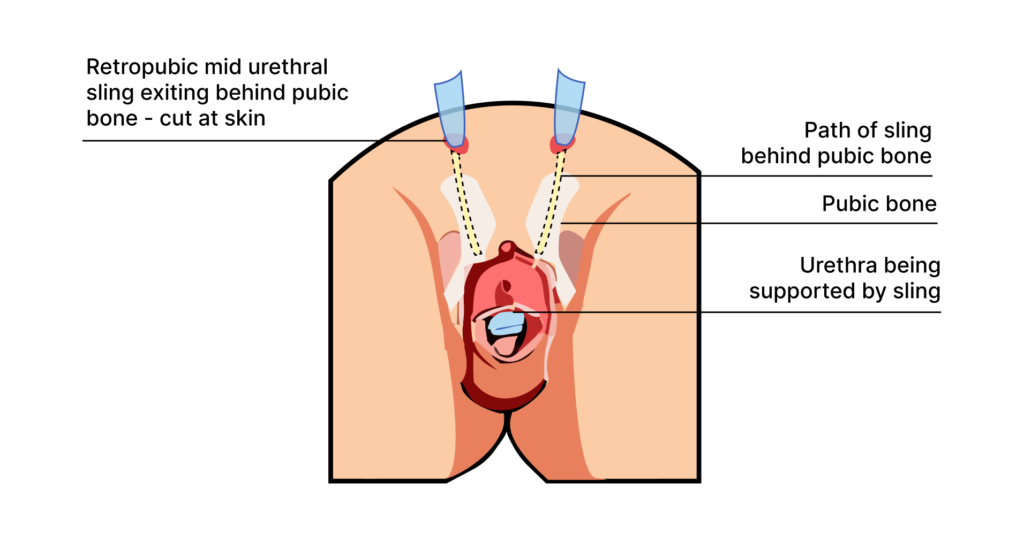
A retropubic mid urethral sling procedure is a minimally invasive surgery used to treat stress urinary incontinence. A narrow permanent strip of synthetic mesh is vaginally placed under the urethra and behind (thus the term 'retro') the pubic bone. This synthetic material forms a sling around the urethra, stabilising it during laughing, coughing, sneezing and running. The procedure has established decades of high success rates, low complications and high patient satisfaction.
Under a general anaesthetic, the bladder is emptied and 2 small incisions are made above the pubic bone. After administering some local anaesthetic to the vagina, an incision is made over the urethra through which the permanent synthetic mesh tape is passed in front of the urethra and exiting behind the pubic bone. A camera is then placed in the bladder to ensure that it was not inadvertently damaged during the procedure. The vaginal incision and exit points behind the pubic bone are then closed with absorbable sutures. If needed vaginal prolapse repairs can be done at the same time as well.
While retropubic mid urethral sling is a safe procedure, it is not without risk, as is the case in surgeries where no mesh is used.
The risks include:
Most patients stay in hospital for 1 night.
A catheter is inserted after the operation to allow your bladder to rest and this is removed the following morning for a trial of void, to ensure you are urinating well.
If vaginal repairs were performed during the surgery, a vaginal pack is inserted at the end of the procedure which is also removed the following morning.
In the days following surgery, temporary changes in your bowel and bladder habit are normal. This includes urinary urgency, frequency and constipation. In addition, one may experience light vaginal bleeding and discharge. In the vast majority of cases, these symptoms self resolve after 1-2 weeks.
During your stay in hospital and when you return home, you will be provided with adequate pain relief in the form of medications to support your recovery. One of the benefits of a laparoscopic approach is a much quicker recovery compared to open surgery.
You will be provided with a designated phone number to directly contact Dr Shahid following your surgery, should you have any acute concerns. In the case of an emergency, always dial 000.
You can expect some fatigue for the first few days following surgery. During this time, light activities like walking and ensuring you are adequately hydrated are encouraged. This reduces your risk of venous thromboembolism.
You will be contacted by our team and have your post-operative appointment booked in 6 weeks time. We will ensure that you are closely followed up.
What to avoid:
A pubovaginal sling is a surgical procedure to treat stress urinary incontinence by supporting the urethra with either:
There is no mesh used in this sling surgery.
Under a general anaesthetic a 'mini laparotomy', similar to a small caeserean section (or bikini line) incision is made and a thin strip (10x2cm) of your rectus sheath is harvested. After dissected behind the pubic bone, a vaginal incision is made and the harvested rectus sheath is used as a sling to support the urethra. The sling is then tied abdominally and the rectus sheath defect closed with absorbable sutures.
Given that a larger incision is required for this procedure through a laparotomy, patients have a longer hospital stay and longer recovery. For this reason, the pubovaginal sling surgery is usually reserved as a secondary treatment, should initial measures fail.
While a pubovaginal sling is a safe procedure, it is not without risk:
The risks include:
Most patients stay in hospital for 2-3 days.
A catheter is inserted after the operation to allow your bladder to rest and this is removed the following morning for a trial of void, to ensure you are urinating well.
In the days following surgery, temporary changes in your bowel and bladder habit are normal. This includes urinary urgency, frequency and constipation. In addition, one may experience light vaginal bleeding and discharge. In the vast majority of cases, these symptoms self resolve after 1-2 weeks.
During your stay in hospital and when you return home, you will be provided with adequate pain relief in the form of medications to support your recovery. Given that this is an open surgery, there is increased pain following the operation (compared to a laparoscopic procedure) and longer recovery period.
You will be provided with a designated phone number to directly contact Dr Shahid following your surgery, should you have any acute concerns. In the case of an emergency, always dial 000.
You can expect some fatigue for the first few days following surgery. During this time, light activities like walking and ensuring you are adequately hydrated are encouraged. This reduces your risk of venous thromboembolism.
You will be contacted by our team and have your post-operative appointment booked in 6 weeks time. We will ensure that you are closely followed up.
What to avoid:
Urethral bulking agents are a temporary measure to treat stress incontinence. The procedure uses a special cystoscope to inject a filler known as polyacrylamide hydrogel into the sub-mucosal layer of the urethra. This doesn't correct urethral hypermobility but rather increases urethral resistance and helps improve the sphincters closure mechanism, thereby decreasing urinary leakage.
Compared to other interventions for stress incontinence, urethral bulking agents have a lower success rate. But given there is no mesh and no vaginal or abdominal incisions it is a very low risk procedure with almost no recovery period. In addition, the body naturally absorbs the bulking agent over time, thus it only works for 9-12 months and further bulking agent injections are required thereafter.
For these reasons, the procedure is usually reserved for women who may not be suitable for a major surgery (due to frailty or significant medical issues) and prefer a less invasive option understanding the lower success rates.
While urethral bulking agent is a safe procedure, it is not without risk:
The risks include:
Urethral bulking agents is a day procedure, meaning there is no overnight stay in hospital.
Following the procedure there is no catheter and in recovery the nurses perform a trial of void to make sure you are urinating well.
In the days following surgery, changes in your bladder habit are normal. This includes urinary urgency and frequency. In addition, one may experience light vaginal bleeding and discharge. In the vast majority of cases, these symptoms self resolve after 1-2 days.
During your stay in hospital and when you return home, you will be provided with adequate pain relief in the form of medications to support your recovery. There is usually little to no pain following urethral bulking agents.
You will be provided with a designated phone number to directly contact Dr Shahid following your surgery, should you have any acute concerns. In the case of an emergency, always dial 000.
You can expect some fatigue for the first few days following surgery. During this time, light activities like walking and ensuring you are adequately hydrated are encouraged. This reduces your risk of venous thromboembolism.
You will be contacted by our team and have your post-operative appointment booked in 6-8 weeks time. We will ensure that you are closely followed up.
What to avoid:
There are no specific restrictions following urethral bulking agents, but it is wise to avoid heavy lifting, high impact exercise and sexual intercourse in the post operative periods (ie: the first 3 days).
Leaking with laughing, coughing, sneezing or exercise is common, but it is not normal and you don't have to put up with it. With highly subspecialised Urogynaecology training in stress urinary incontinence, Dr Shahid brings to the Illawarra the regions first full time Urogynaecology service.
Through experience in high volume centres, publications of world renowned research and a broad clinical and surgical expertise, Dr Shahid brings a comprehensive and holistic approach in the community he calls home, centring his up to date practice around their care. With an ever growing population in the Illawarra and an increased awareness of stress urinary incontinence, Dr Shahid hopes to restore a sense of normality and confidence to the women he treats.
You don't have to live with leakage.


Not necessarily. Management options involve doing watching and waiting (and observing progress), conservative (or non surgical options) and then surgical options. Dr Shahid will discuss all available options for your prolapse as an individualised experience. The decision to proceed with any management is always your choice.
Yes, referrals are required in order for you to obtain Medicare rebates. Please see your GP and mention you want a referral to see Dr Usama Shahid or otherwise contact our rooms and we will guide you to known GP’s for referrals.
Anytime you are bothered by your symptoms and they are affecting your quality of life. All options for management will be openly discussed with you. There are treatments available.
Pelvic floor health is personal, and Dr Shahid understands that. He is committed to making every patient feel at ease. Your first consultation is an opportunity to discuss your symptoms in a confidential, supportive environment. Dr Shahid will take a history, perform an examination to assess your pelvic floor and if needed do further tests like urodynamics and ultrasound before having a robust discussion about options available to you. Thus allowing you to make an informed decision about your care.