Pelvic Organ Prolapse



The weakness means that the pelvic organs can no longer be adequately supported or held in place. As a result, women experience a multitude of symptoms including:
As a certified Urogynaecologist with subspecialty training, Dr Usama Shahid leads the pelvic organ prolapse specialist Wollongong service providing dedicated expertise in prolapse and an individualised approach to diagnosis and treatment. His subspecialty focus facilitates for a full spectrum of management options from conservative strategies all the way through to advanced pelvic floor reconstructions tailored to your anatomy, symptoms and personal goals. With an overarching goal of restoring function to help you reclaim your life, these comprehensive services are available right now, here in the Illawarra.

Pelvic organ prolapse is a common condition, with roughly 50% of women worldwide experiencing prolapse symptoms following childbirth, yet less than half of those seek medical attention. The risk factors for developing pelvic organ prolapse include:
As a Urogynaecology subspecialist focussing on the pelvic floor, Dr Usama Shahid and his healthcare team look forward to discussing the most up to date treatment choices with you on this journey to reclaim your health. See below for more information.
Although pelvic organ prolapse is usually not life threatening, for most women it can have a significant impact on their quality of life. In rare circumstances, if left untreated prolapse can cause complications including severe pain, ulceration of the vagina, urinary incontinence, retention, infections and damage to other parts of your body like the kidneys.
Diagnosis of pelvic organ prolapse begins with a medical history to understand your individual concerns and general health followed by a pelvic exam. This is done by a healthcare professional to ascertain the type of prolapse you have and the strength of your pelvic floor. It is important to discuss your symptoms and any concerns you have to determine the best treatment plan for you.
Following this, management is individualised based on your personal preferences, general health, examination findings and investigations.
In general terms, management options can be divided into 3 broad groups: doing nothing, conservative management and surgical management.
Observing symptoms with ongoing follow up.
Pelvic floor muscle training is a coordinated program of supervised exercises done with a healthcare professional. The aim of pelvic floor exercises is to strengthen and support the muscles of the pelvic floor in women, thereby decreasing your bulge and urinary incontinence symptoms. Dr Shahid works closely with several local physiotherapists specialising in pelvic floor exercises to keep your pelvic floor muscles strong. Below is a basic regime you can implement while awaiting review:
Vaginal pessary is a removable silicone device placed inside of the vagina by a doctor. It supports and replaces the prolapse while taking some pressure off the muscles of the pelvic floor. Risks of pessary use include discomfort, difficulty with insertion or removal and ulceration of the vagina. In very rare cases a fistula can develop.
Vaginal oestrogen therapy is a safe, topical cream which strengthens vaginal tissues. It is a low risk intervention but occasionally some women develop a local reaction to it which usually resolves after cessation of use. There is well established long term data that the use of vaginal oestrogen is safe in women with a previous history of breast cancer.
Lifestyle changes to avoid heavy lifting as over long periods of time recurrent heavy lifting places excessive pressure on the pelvic floor muscles leading to weakness.
Altering bladder habits by undertaking a timed voiding regime (emptying bladder every 3 hour) and managing fluid intake.
Managing medical issues including:
The surgical options are individually detailed below with their specific benefits and risks.
Dr Usama Shahid will discuss all available options for your prolapse as an individualised experience. The decision to proceed with any management is always your choice.
Women undergoing surgery for pelvic organ prolapse may be offered various treatments to reduce complications and/or improve outcomes. Dr Usama Shahid has published an internationally recognised Cochrane research project on this, which can be found below.
The surgical treatment options for prolapse are detailed below
Vaginal prolapse is often complex with involvement of multiple compartments that rarely prolapse in isolation but more commonly present together. For this reason, often a time multiple procedures may need to be undertaken at the time of your surgery in order to correct your prolapse.
Below are some surgical procedures which support the upper compartment of vaginal or uterine prolapse.

Sacrocolpopexy is a key-hole or minimally invasive procedure which is considered the 'gold-standard' for the surgical correction of vaginal vault prolapse. This is based on good long term outcomes, high patient satisfaction and low complication rates.
Vaginal vault prolapse occurs in people who have had a hysterectomy, causing the top of the vagina to lose its support and drop. Sacrocolpopexy lifts the vagina back to its normal position by suspending it with permanent mesh to a ligament on the sacrum. After dissection of the bladder and rectum, the mesh supports the vagina and the lining of the abdominal cavity (peritoneum) is closed over the mesh. The procedure is often performed concurrently with a paravaginal repair and if needed a posterior repair at the same surgery.
The use of abdominal mesh is very different to that of vaginal mesh (which is no longer used for prolapse in Australia following the Senate enquiry). Due to its location and axis of placement, abdominal mesh has significantly lower rates of mesh related complications compared to vaginal mesh. It is important to understand, that the mesh used for sacrocolpopexy is primarily used for hernia repairs. While this use is considered 'off-label' use, pelvic organ prolapse is a type of hernia. In addition, the mesh has been used abdominally for decades with good outcomes and low rates of complications. Dr Shahid is a subspecialist Urogynaecologist with a refined technique and surgical skillset.
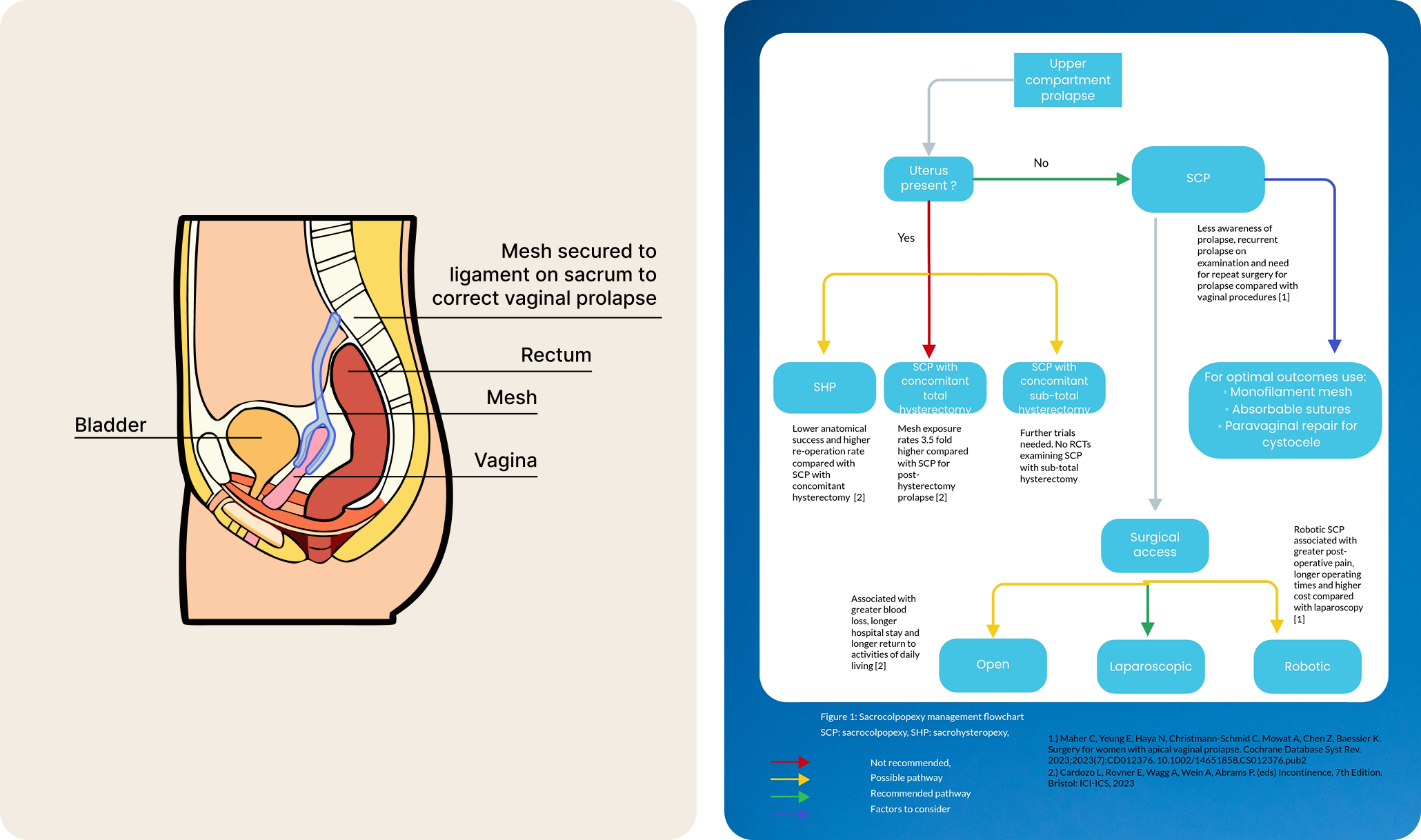
While sacrocolpopexy is safe, it is not without risk, as is the case in surgeries where no mesh is used.
Most patients stay in hospital for 1-2 days. A catheter is inserted after the operation to allow your bladder to rest and this is removed the following morning for a trial of void, to ensure you are urinating well. If vaginal repairs were performed during the surgery, a vaginal pack is inserted at the end of the procedure which is also removed the following morning.
In the days following surgery, temporary changes in your bowel and bladder habit are normal. This includes urinary urgency and constipation. In addition, one may experience light vaginal bleeding and discharge. In the vast majority of cases, these symptoms self resolve after 1-2 weeks.
During your stay in hospital and when you return home, you will be provided with adequate pain relief in the form of medications to support your recovery. One of the benefits of a laparoscopic approach is a much quicker recovery compared to open surgery.
You will be provided with a designated phone number to directly contact Dr Shahid following your surgery, should you have any acute concerns. In the case of an emergency, always dial 000. You can expect some fatigue for the first few days following surgery. During this time, light activities like walking and ensuring you are adequately hydrated are encouraged. This reduces your risk of venous thromboembolism.
You will be contacted by our team and have your post-operative appointment booked in 6 weeks time. We will ensure that you are closely followed up.
A laparoscopic hysterectomy is a surgical procedure to remove the uterus, cervix and fallopian tubes. If you are near the age of menopause or post-menopausal Dr Shahid will discuss the risks and benefits of removing your ovaries with you (at the time of hysterectomy).
After insertion of instruments through small incisions in the abdomen the uterus is removed through the vagina before the back of the vagina is sutured closed. This procedure is done if the uterus is descending as part of your prolapse and you have completed having children. If your uterus is prolapsing and you still want to have more children, uterine sparing options (along with conservative measures) will be discussed with you. The uterus rarely prolapses in isolation and a hysterectomy is often done in conjunction with an anterior/posterior vaginal repair and sacrospinous fixation.
From a general gynaecology point of view, following a hysterectomy your menstrual periods will cease and if your cervical screening tests are up to date and negative, you will no longer require pap smears.
While a laparoscopic hysterectomy is a safe procedure, it is not without risk:
Most patients stay in hospital for 2-3 days.
A catheter is inserted after the operation to allow your bladder to rest and this is removed the following morning for a trial of void, to ensure you are urinating well.
If vaginal repairs were performed during the surgery, a vaginal pack is inserted at the end of the procedure which is also removed the following morning.
In the days following surgery, temporary changes in your bowel and bladder habit are normal. This includes urinary urgency and constipation. In addition, one may experience light vaginal bleeding and discharge. In the vast majority of cases, these symptoms self resolve after 1-2 weeks.
During your stay in hospital and when you return home, you will be provided with adequate pain relief in the form of medications to support your recovery. One of the benefits of a laparoscopic approach is a much quicker recovery compared to open surgery.
You will be provided with a designated phone number to directly contact Dr Shahid following your surgery, should you have any acute concerns. In the case of an emergency, always dial 000.
You can expect some fatigue for the first few days following surgery. During this time, light activities like walking and ensuring you are adequately hydrated are encouraged. This reduces your risk of venous thromboembolism.
You will be contacted by our team and have your post-operative appointment booked in 6 weeks time. We will ensure that you are closely followed up.
Sacrospinous ligament fixation and sacrospinous hysteropexy are both surgical procedures done via a vaginal approach in order to correct a vaginal vault or uterine prolapse. The sacrospinous ligament is a strong ligament extending from the sacrum to the pelvis which is access vaginally in order to suspend the vaginal wall or uterus.
Sacrospinous ligament fixation is for vaginal vault prolapse while a sacrospinous hysteropexy is for uterine prolapse (whereby the uterus along with the vaginal wall is suspended to the sacrospinous ligament). A sacrospinous hysteropexy is an option if you are wanting a surgical repair of your uterine prolapse and want to maintain the option of having further children in the future. These procedures are routinely done in conjunction with an anterior and/or posterior vaginal repair. There is no mesh used in this procedure.
While a sacrospinous ligament fixation is a safe procedure, it is not without risk:
Most patients stay in hospital for 1 night.
A catheter is inserted after the operation to allow your bladder to rest and this is removed the following morning for a trial of void, to ensure you are urinating well.
In the days following surgery, temporary changes in your bowel and bladder habit are normal. This includes urinary urgency and constipation. In addition, one may experience light vaginal bleeding and discharge. In the vast majority of cases, these symptoms self resolve after 1-2 weeks.
During your stay in hospital and when you return home, you will be provided with adequate pain relief in the form of medications to support your recovery. One of the benefits of a colpocleisis is that recovery from surgery is usually smooth and quick.
You will be provided with a designated phone number to directly contact Dr Shahid following your surgery, should you have any acute concerns. In the case of an emergency, always dial 000.
You can expect some fatigue for the first few days following surgery. During this time, light activities like walking and ensuring you are adequately hydrated are encouraged. This reduces your risk of venous thromboembolism.
You will be contacted by our team and have your post-operative appointment booked in 6 weeks time. We will ensure that you are closely followed up. At this appointment it is common for women to be placed on vaginal oestrogen therapy.
Colpocleisis is a vaginal surgical procedure used to treat pelvic organ prolapse by closing (or obliterating) the vaginal canal thereby supporting the prolapsed organs.
Under an anaesthetic (spinal or general), the vaginal epithelium overlying the bladder and rectum is dissected before being sutured together in a dozen or so layers. This prevents the prolapse from descending down. Channels are left open to allow for normal vaginal discharge to drain. There is no mesh used during a colpocleisis.
The benefits of a colpocleisis compared to more invasive procedures like a hysterectomy or sacrospinous ligament fixation is that it has:
The issues or drawbacks of a colpocleisis are:
For these reasons, this surgery is usually reserved for patients who are no longer sexually active and have significant medical issues or frailty making them unsuitable for a more invasive procedure.
While a colpocleisis is a safe procedure, it is not without risk:
The risks include:
Most patients stay in hospital for 1 night.
A catheter is inserted after the operation to allow your bladder to rest and this is removed the following morning for a trial of void, to ensure you are urinating well.
In the days following surgery, temporary changes in your bowel and bladder habit are normal. This includes urinary urgency and constipation. In addition, one may experience light vaginal bleeding and discharge. In the vast majority of cases, these symptoms self resolve after 1-2 weeks.
During your stay in hospital and when you return home, you will be provided with adequate pain relief in the form of medications to support your recovery. One of the benefits of a colpocleisis is that recovery from surgery is usually smooth and quick.
You will be provided with a designated phone number to directly contact Dr Shahid following your surgery, should you have any acute concerns. In the case of an emergency, always dial 000.
You can expect some fatigue for the first few days following surgery. During this time, light activities like walking and ensuring you are adequately hydrated are encouraged. This reduces your risk of venous thromboembolism.
You will be contacted by our team and have your post-operative appointment booked in 6 weeks time. We will ensure that you are closely followed up. At this appointment it is common for women to be placed on vaginal oestrogen therapy.
Prolapse of the middle compartment involves the 'front wall' (known as a cystocele) and/or the 'back wall' (known as a rectocele). A cystocele is a type of anterior prolapse that most often involves the bladder while a rectocele is a type of posterior prolapse that involves the rectum. These occur when the bladder and bowel protrudes into the vagina.
Patients may experience bulge symptoms, a difficulty emptying their bowel and/or bladder, sexual dysfunction, urinary tract infections and general discomfort. In some cases, women describe 'manual digitation' whereby they have to insert their fingers into their vagina in order to replace their prolapse and help empty their bowel and/or bladder.
In addition to the conservative (non surgical treatments) mentioned prior, below are a list of the surgical treatment options available for middle compartment prolapse.
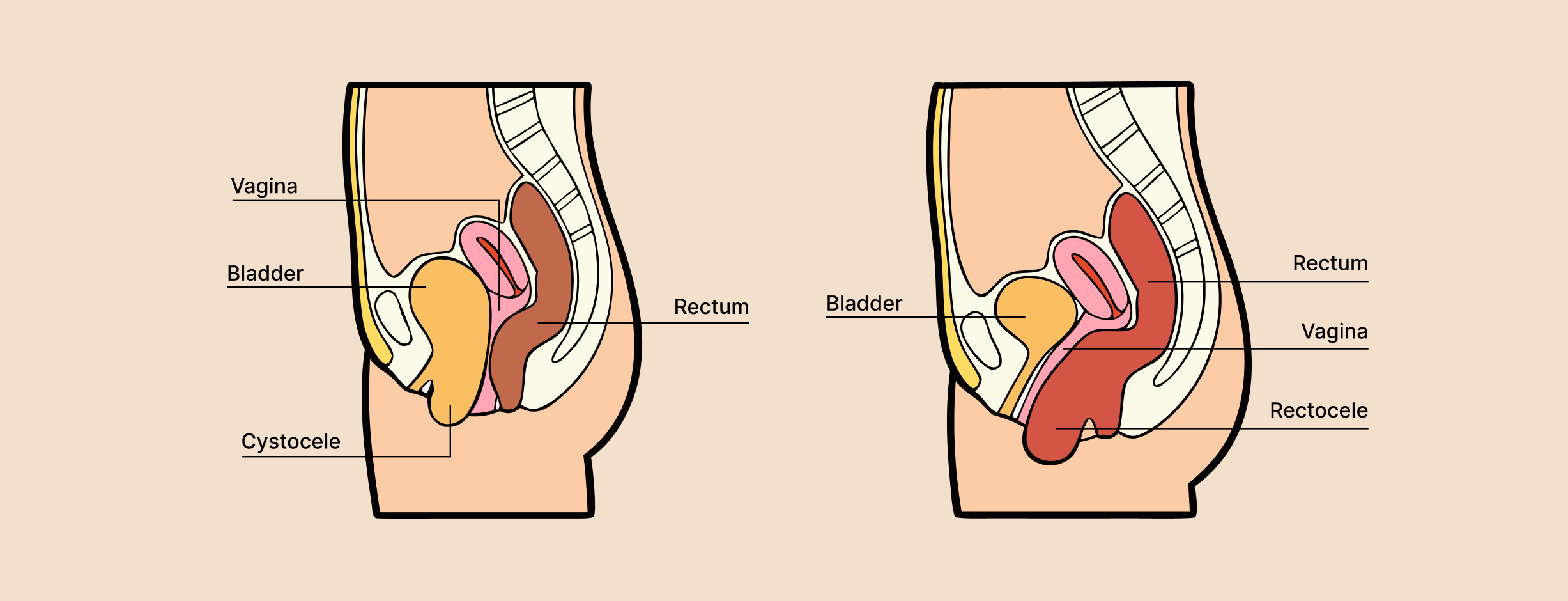
An anterior and posterior vaginal repair is a vaginal surgical procedure to repair bladder and bowel prolapse. Performed under a general anaesthetic, the front and back wall of the vagina are dissected before absorbable sutures are used to repair the fascia (connective tissue) supporting the bladder and rectum. The procedure is often combined with a sacrospinous ligament fixation and there is no mesh used.
The aim is to objectively replace the prolapse but also improve your functional symptoms. The procedure is designed to maintain vaginal length and calibre thus not only relieving the bulge symptoms but also facilitating sexual intercourse and bladder/bowel emptying.
While a anterior/posterior vaginal repair is a safe procedure, it is not without risk:
Most patients stay in hospital for 1-2 days.
A catheter is inserted after the operation to allow your bladder to rest and this is removed the following morning for a trial of void, to ensure you are urinating well.
In the days following surgery, temporary changes in your bowel and bladder habit are normal. This includes urinary urgency and constipation. In addition, one may experience light vaginal bleeding and discharge. In the vast majority of cases, these symptoms self resolve after 1-2 weeks.
During your stay in hospital and when you return home, you will be provided with adequate pain relief in the form of medications to support your recovery.
You will be provided with a designated phone number to directly contact Dr Shahid following your surgery, should you have any acute concerns. In the case of an emergency, always dial 000.
You can expect some fatigue for the first few days following surgery. During this time, light activities like walking and ensuring you are adequately hydrated are encouraged. This reduces your risk of venous thromboembolism.
You will be contacted by our team and have your post-operative appointment booked in 6 weeks time. We will ensure that you are closely followed up. At this appointment it is common for women to be placed on vaginal oestrogen therapy.
A laparoscopic paravaginal repair is a keyhole operation for the correction of a 'front wall' prolapse otherwise known as a cystocele. The procedure also corrects stress urinary incontinence.
Under a general anaesthetic, surgical instruments are inserted through small incisions in the abdomen. Following this, the space above the bladder known as the retro-pubic space (or Cave of Retzius) is dissected. The vaginal tissue around the urethra is then elevated, and suspended with permanent sutures to the ileopectineal ligament above the pubic bone. This lifts the vagina thus correcting the prolapse and forms a 'hammock' around the urethra thus supporting it.
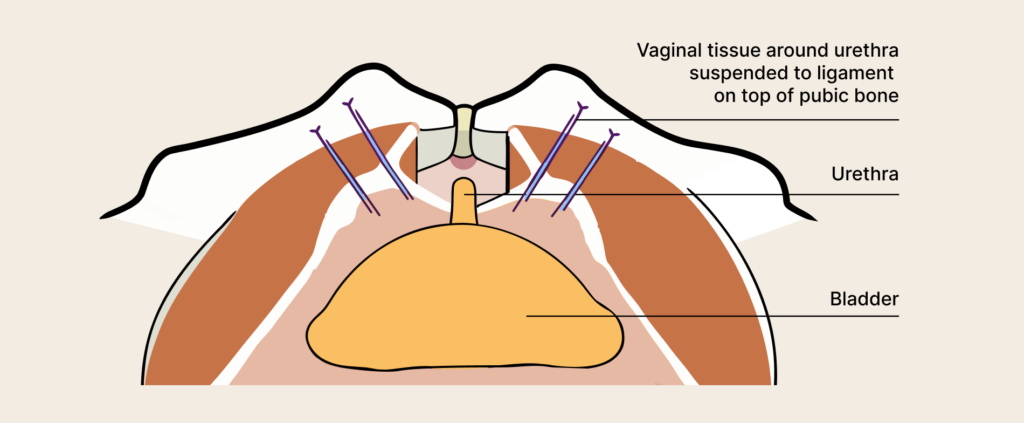
While a laparoscopic paravaginal repair is a safe procedure, it is not without risk:
Most patients stay in hospital for 1-2 days.
A catheter is inserted after the operation to allow your bladder to rest and this is removed the following morning for a trial of void, to ensure you are urinating well.
In the days following surgery, temporary changes in your bowel and bladder habit are normal. This includes urinary urgency and constipation. In addition, one may experience light vaginal bleeding and discharge. In the vast majority of cases, these symptoms self resolve after 1-2 weeks.
During your stay in hospital and when you return home, you will be provided with adequate pain relief in the form of medications to support your recovery. One of the benefits of a laparoscopic approach is a much quicker recovery compared to open surgery.
You will be provided with a designated phone number to directly contact Dr Shahid following your surgery, should you have any acute concerns. In the case of an emergency, always dial 000.
You can expect some fatigue for the first few days following surgery. During this time, light activities like walking and ensuring you are adequately hydrated are encouraged. This reduces your risk of venous thromboembolism.
You will be contacted by our team and have your post-operative appointment booked in 6 weeks time. We will ensure that you are closely followed up.
Prolapse of the lower compartment usually occurs following vaginal childbirth. It is characterised by vaginal laxity or 'looseness' and associated sexual dysfunction through a wide or enlarged genital hiatus. Patients may also complain of vaginal 'flatus' which understandably causes significant embarrassment and distress. Futhermore, since the urethra is also in the lower third of the vagina, patients may also experience stress urinary incontinence which is discussed separately.
In addition to the conservative (non surgical treatments) mentioned prior, a perineoplasty can be considered as part of surgical management for lower compartment prolapse.

A perineoplasty is a vaginal surgical procedure aimed at correcting the widening of the vaginal hiatus and re-approximating the detached perineal muscles.
Under a general anaesthetic, a vaginal incision is made and the tissue overlying the perineal muscle and rectum is dissected. Following this the perineal muscles are re-approximated together with absorbable sutures thereby restoring normal vaginal calibre.
The procedure is designed to restore functional symptoms above just a cosmetic correction.
While a perineoplasty is a safe procedure, it is not without risk:
Most patients stay in hospital for 1-2 days.
A catheter is inserted after the operation to allow your bladder to rest and this is removed the following morning for a trial of void, to ensure you are urinating well.
In the days following surgery, temporary changes in your bowel and bladder habit are normal. This includes urinary urgency and constipation. In addition, one may experience light vaginal bleeding and discharge. In the vast majority of cases, these symptoms self resolve after 1-2 weeks.
During your stay in hospital and when you return home, you will be provided with adequate pain relief in the form of medications to support your recovery.
You will be provided with a designated phone number to directly contact Dr Shahid following your surgery, should you have any acute concerns. In the case of an emergency, always dial 000.
You can expect some fatigue for the first few days following surgery. During this time, light activities like walking and ensuring you are adequately hydrated aro encouraged. This reduces your risk of venous thromboembolism.
You will be contacted by our team and have your post-operative appointment booked in 6 weeks time. We will ensure that you are closely followed up. At this appointment it is common for women to be placed on vaginal oestrogen therapy.
Dr Shahid is a Urogynaecologist with a subspecialist focus on pelvic organ prolapse. Through experience in high volume centres, publications of world renowned research and a broad clinical and surgical expertise, he brings to the Illawarra the regions first full time Urogynaecology service.
This allows for a holistic approach to local patients in the community he calls home, centring his up to date practice around their care. With an ever growing population in the Illawarra and an increased awareness of pelvic organ prolapse, Dr Shahid hopes to restore a sense of normality and confidence to the women he treats.


Not necessarily. Management options involve doing watching and waiting (and observing progress), conservative (or non surgical options) and then surgical options. Dr Shahid will discuss all available options for your prolapse as an individualised experience. The decision to proceed with any management is always your choice.
Yes, referrals are required in order for you to obtain Medicare rebates. Please see your GP and mention you want a referral to see Dr Usama Shahid or otherwise contact our rooms and we will guide you to known GP’s for referrals.
Anytime you are bothered by your symptoms and they are affecting your quality of life. All options for management will be openly discussed with you. There are treatments available.
Pelvic floor health is personal, and Dr Shahid understands that. He is committed to making every patient feel at ease. Your first consultation is an opportunity to discuss your symptoms in a confidential, supportive environment. Dr Shahid will take a history, perform an examination to assess your pelvic floor and if needed do further tests like urodynamics and ultrasound before having a robust discussion about options available to you. Thus allowing you to make an informed decision about your care.